
What happens to a pair of jeans after you stop wearing them?
For most people, the story ends when the jeans leave the wardrobe.
At dwij, that's where another story begins.
Inside our Mumbai upcycling unit, discarded jeans move through six carefully considered stages before they become upcycled bags, accessories, home goods, and other everyday products.
There is no magic involved.
There are piles of denim, scissors, sewing machines, irons, thread, skilled hands, and a lot of careful decision-making.
The process is simple enough to describe in six words:
Sourcing. Sorting. Washing. Cutting. Stitching. Ironing.
But behind each word is a team of people making sure as little useful material as possible goes to waste.
This is what a day inside our upcycling unit looks like.
Step 1: Sourcing
Every dwij product begins with material that has already lived another life.
Our raw material base includes post-consumer jeans and post-industrial denim and textile waste. Instead of treating these materials as something with no further use, we look for the parts that can be rescued and redesigned.
A pair of jeans may have been worn for years before it reaches us.
It may have faded at the knees.
Its pockets may have softened.
The denim may carry creases and marks from everyday life.
We don't see those details as problems.
They are part of the material's history.
This is the beginning of the dwij philosophy: द्वि ज (dwij) means "twice born" in Sanskrit, a material gets another chance to become something useful.
Step 2: Sorting
Once the denim arrives, the next question is simple:
What can still be used?
This is where Sorting begins.
Different pieces of denim have different strengths, sizes, colours, fades, and textures. Some sections are ideal for large panels. Others are better suited to smaller components or patchwork.
Sorting requires an experienced eye.
It's also one of the places where the human element of upcycling becomes particularly important.
At dwij, we don't simply process denim as one uniform raw material. We examine what we have and make design decisions around it.
This approach supports our zero-waste discipline: scraps and smaller pieces can become part of patchwork rather than automatically becoming waste.
The result?
A material that looks like a pile of old jeans begins to reveal its possibilities.
Step 3: Washing
Before old denim can become one of our upcycled denim bags or other products, it needs to be prepared.
That's where washing comes in.
The rescued denim is cleaned and prepared for its next life.
But washing isn't about making reclaimed denim look brand new.
At dwij, we value the authentic character that already exists in the material. Natural fading, texture, and signs of previous wear are part of what makes reclaimed denim interesting.
We don't use chemicals to create artificial washed effects.
The denim gets to keep the character that time has already given it.
This is an important distinction.
Upcycling doesn't mean pretending an old material is new.
It means seeing value in what already exists.
Step 4: Cutting
This is where a pile of jeans begins to look like a future product.
Cutting requires planning.
The maker has to consider the available denim, its condition, its size, its existing seams, and the design of the product.
Every cut matters.
Cut too much, and useful material may be lost.
Plan carefully, and even smaller sections can find another purpose.
This is why cutting is much more than simply putting scissors to fabric.
It is a design decision.
The goal is to make the most of what already exists.
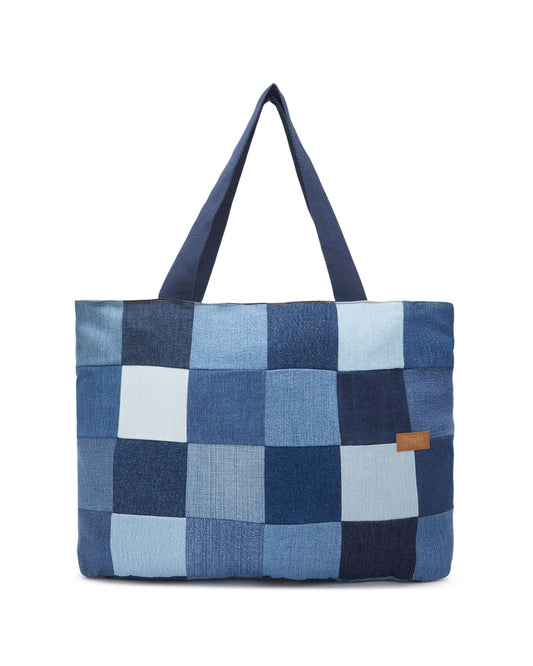
A strong denim panel might become part of a denim tote bag.
A pocket might become a useful feature on a denim backpack.
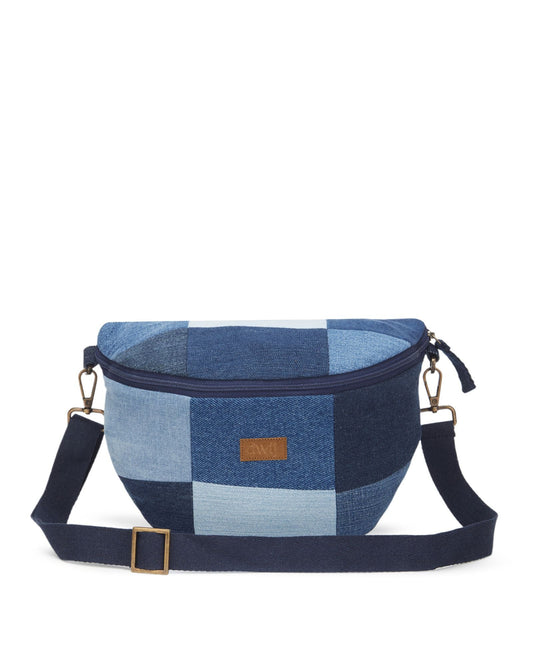
Smaller pieces can contribute to patchwork designs.
At dwij, this is part of our design-for-disassembly and zero-waste approach: every element is carefully considered rather than treated as disposable.
Step 5: Stitching
Now the separate pieces begin to become a product.
Stitching is where the skill of the maker becomes visible.
Panels are joined.
Pockets are attached.
Straps are constructed.
Patchwork comes together.
The sewing machine moves, thread passes through denim, and gradually the shape of the final product appears.
This is also where dwij's belief in people-centred craft comes into focus.
Our products are tailor-made rather than mass manufactured, and we believe the people who make them should be visible and credited.
That is why our "I Made Your Bag" campaign introduces the people behind the products.
A bag isn't simply "made by dwij."
It is made by people.
People with names.
People with skills.
People whose experience determines how a product comes together.
Step 6: Ironing
The final step is Ironing.
It may seem like a small part of the process.
It isn't.
After cutting, stitching, assembling, and finishing, ironing helps prepare the product for its final presentation.
The fabric settles.
Seams are pressed.
Edges become neater.
The product takes its finished shape.
And suddenly, what began as a discarded pair of jeans is ready for another life.
Ready to become something someone carries to work.
Something they take on a trip.
Something they use every day.
Something they keep.
Six Steps. One Second Life.
Sourcing.
Sorting.
Washing.
Cutting.
Stitching.
Ironing.

Six steps that turn a material's ending into a beginning.
But the process isn't really about making old jeans look new.
It is about making them useful again.
That distinction matters.
At dwij, we don't believe sustainability requires hiding where a material came from. Our philosophy is to honour the character of reclaimed materials, their fading, texture, variation, and history and build something valuable from them.
That's why no two dwij products are exactly alike.
The denim itself is different.
The fades are different.
The patches are different.
And the hands that make each product bring their own experience to the process.
What Happens to the Leftover Denim?
Upcycling isn't successful if one product simply creates another pile of waste.
That's why smaller denim pieces matter too.

Scraps can become patchwork.
Panels that aren't suitable for one design may work in another.
Different pieces can be combined to create something completely new.
This is the thinking behind our zero-waste patchwork designs and our broader circular approach.
The objective isn't perfection.
It is better used.
From a Pair of Jeans to Something You Can Carry
A pair of jeans has a surprisingly long journey at dwij.
It begins as clothing.
Then it becomes raw material.

It is sourced, sorted, washed, cut, stitched, and ironed.
Eventually, it may become one of our denim bags, tote bags, backpacks, sling bags, or another product designed for everyday use.
The material changes.
Its purpose changes.
But its story doesn't disappear.
That is what "second life" means to us.
Why We Show the Process
Sustainability can become an abstract word when you only see the finished product.
We prefer to show the hands, tools, materials, and steps behind it.

Because transparency matters.
You should know where the material came from.
You should understand how it was transformed.
And you should know that a handcrafted product is not created instantly.
There is time behind it.
There is skill behind it.
There are people behind it.
Our brand guidelines call for exactly this kind of process storytelling—from sourcing → washing → sorting → cutting → stitching → finished product—because the journey is part of the product's story.
The Next Time You Look at an Old Pair of Jeans
You might see a worn-out garment.
We see possibilities.
A pocket.
A panel.
A patch.
A seam.
A texture.
A story.

The next time an old pair of jeans reaches the end of its wardrobe life, perhaps the question doesn't have to be:
"Where can I throw this away?"
It can be:
"What could this become?"
At dwij, that's where the journey begins.
Frequently Asked Questions
What are the six steps in dwij's denim upcycling process?
The six signature steps are Sourcing, Sorting, Washing, Cutting, Stitching, and Ironing. Together, these stages transform rescued denim into handcrafted products designed for a second life.
Where does dwij get its denim?
dwij works with post-consumer jeans and post-industrial denim and textile waste. These materials form the raw material base for its upcycled products.
What happens to old jeans at an upcycling unit?
At dwij, rescued jeans move through six stages: Sourcing, Sorting, Washing, Cutting, Stitching, and Ironing. The denim is assessed, prepared, cut according to product requirements, stitched by skilled makers, and finished before becoming a new product.
How are old jeans turned into bags?
Useful denim sections are selected during Sorting and Cutting. They are then assembled and stitched into products such as upcycled bags, tote bags, backpacks, and sling bags, depending on the design.
Does dwij use chemicals to create faded denim?
No. dwij's brand philosophy is to preserve the authentic character of reclaimed denim rather than chemically creating artificial washed effects. Natural fading, wear, and variation are treated as features of the material.
Why does every dwij product look slightly different?
dwij uses reclaimed denim, so every pair of jeans brings its own colour, fade, texture, and history. Since the products are handcrafted and not mass manufactured, variation is natural and no two dwij products are identical.
What happens to small denim scraps?
Smaller usable pieces can become part of patchwork and other designs. This supports dwij's zero-waste discipline, where scraps are considered potential material rather than automatically treated as waste.
Who makes dwij's products?
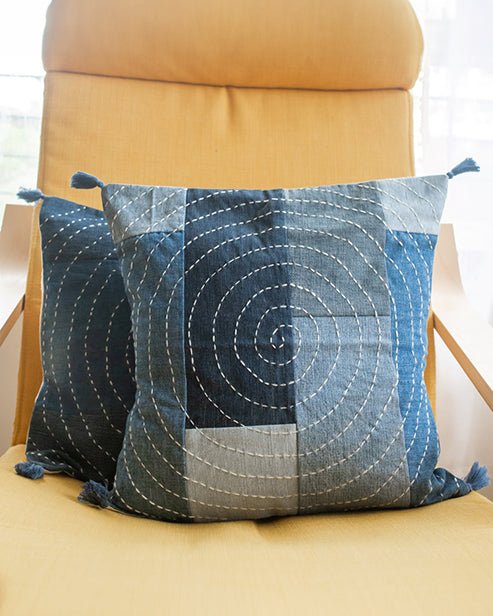
dwij's products are made by skilled makers who contribute to different stages of the process, including cutting, tailoring, stitching, patchwork, embroidery, and finishing. The "I Made Your Bag" campaign gives visibility and credit to the people behind the products rather than treating them as anonymous labour.
What does dwij mean?
dwij (द्वि ज) means "twice born" in Sanskrit. The name reflects the brand's philosophy of giving discarded materials a meaningful second life.
What can I find in the dwij collection?
The dwij range includes bags, accessories, jewellery, home goods, and products for men. The bag category includes slings, baguettes, totes, backpacks, laptop bags and sleeves, convertibles, messengers, fanny packs, zippered totes, mobile slings, and duffles.