
A pair of jeans can spend years as someone's everyday clothing.
It moves through commutes, weekends, journeys, pockets filled with receipts, and countless ordinary days. Eventually, it may become too worn, too small, or simply no longer wanted.
But what happens after that?
At Dwij, this is where the story changes.
Instead of treating discarded denim as the end of the line, the material enters a six-step transformation process that can turn it into something completely different: a bag, backpack, tote, sling or another everyday product.
Sourcing. Sorting. Washing. Cutting. Stitching. Ironing.
Six steps.
One material with a previous life.
And a very different one ahead.
Step 1: Sourcing — Finding Denim With More Life Left
Every Dwij product begins with material.
Dwij works with post-consumer jeans and post-industrial denim and textile waste. Post-consumer denim includes jeans that have already been used, while post-industrial material can include usable manufacturing leftovers and textile waste.
The interesting part is that the denim doesn't arrive as a neat roll of identical fabric.
One pair may be dark indigo.
Another may have naturally faded knees.
Some may have softer, more worn areas, while other sections are still strong and sturdy.
There can be pockets, seams, waistbands and other construction details that already exist in the garment.
So sourcing isn't simply about finding "old jeans."
It is about finding usable material with another life in it.
Step 2: Sorting — Looking at What Each Pair Can Become
Once the denim has been sourced and prepared, it needs to be understood.
At Dwij, denim is sorted according to characteristics such as size, GSM, shade and usability. The condition, texture, natural fading and usable fabric area also influence how a piece can be used.
This is where upcycling differs from working with a completely uniform new fabric.
The designer cannot simply say, "I need another metre of this exact shade."
Instead, the design has to respond to what already exists.
A strong section might become part of a large bag panel.
A smaller piece could become part of a patchwork design.
A pocket might find another purpose.
A heavily worn section may not be suitable for a load-bearing component.
The question is not simply "Can these jeans be used?"
It is:
"Which part can be used, and what is it best suited for?"
Step 3: Washing — Preparing the Material for Its Second Life
Before the denim enters Dwij's workshop, it is rigorously pre-washed through industrial washing processes handled by sourcing partners.
This is an important part of the journey because post-consumer denim has already had a previous life.
The washing process prepares the material before it becomes part of a new product.
It also answers one of the most common questions people have about upcycled denim:
"But isn't this someone's old clothing?"
Yes.
And that's precisely why the preparation process matters.
The material's previous life is not hidden.
It is cleaned, assessed and prepared before entering production.
Step 4: Cutting — When the Bag Starts Existing on Paper
This may be the most visually satisfying stage.
The jeans stop looking like jeans.
A pattern is marked onto the selected denim, and the material is cut according to the requirements of the product.
But there is another challenge here:
How do you make the most of what you have?
Unlike virgin fabric, rescued denim comes with limitations.
There may be worn areas to work around.
Different shades may need to be positioned intentionally.
Smaller pieces may need to be combined.
Existing seams or pockets may influence the cut.
This is where material knowledge meets design.

The finished denim bag may have a carefully planned shape, but the material itself has helped determine how that shape comes together.
That is one of the defining characteristics of upcycling.
The design responds to the material.
Step 5: Stitching — From Pieces to Product
Now the transformation becomes obvious.
Individual denim pieces begin coming together.
Panels are joined.
Pockets are added.
Straps take shape.
Closures and other components are attached.
Depending on the design, recycled PET felt, zippers, hardware and other components may become part of the construction. Dwij uses materials such as recycled polyester felt and Japanese YKK zippers in its products.
And this is where the phrase "handmade" becomes more than a product description.
Dwij's products are tailor-made rather than mass-produced, with each garment or material handled and cut individually.
The stitching is not simply joining fabric.
It is assembling a completely new function around material that already existed.
A pair of jeans that once carried someone's belongings can now become the thing that carries them again.
Just differently.
Step 6: Ironing — The Quiet Final Transformation
The final step is quieter than cutting or stitching.

But it changes how the finished product looks and feels.
Ironing helps give the newly assembled product a cleaner, more finished appearance and is part of Dwij's documented six-step production process.
By now, it may be difficult to see the original jeans in the finished object.
The shape has changed.
The function has changed.
The individual pieces have been reconstructed.
But traces of the original material can still remain:
A natural fade.
A pocket.
A seam.
A slightly different shade of blue.
A texture created by years of wear.
The transformation doesn't erase the material's history.
It carries it forward.
What Happens to the Smaller Pieces?
Turning a pair of jeans into a bag does not mean every part of the jeans automatically fits into that one bag.
That's why the smaller pieces matter.
At Dwij, denim scraps can be used in patchwork and other applications where smaller pieces can still have a purpose. This approach is part of the brand's effort towards lower-waste production.
A tiny piece of denim may not be large enough for a tote panel.
But it doesn't have to be.
It could become part of a patch.
Or contribute to another design.
Or wait for the right future use.
Upcycling is therefore not simply about changing one old product into one new product.
It is about looking at the material in smaller and smaller pieces until you understand what can still be useful.
The Same Jeans Won't Always Become the Same Bag
This is one of the reasons upcycled bags can look different from one another.

When the raw material is rescued rather than newly manufactured, variation is part of the process.
Different denim shades.
Different fades.
Different textures.
Different usable areas.
Different combinations.
Two products based on a similar design can therefore still have their own visual character.
Instead of trying to hide those differences, upcycling can make them part of the finished product.
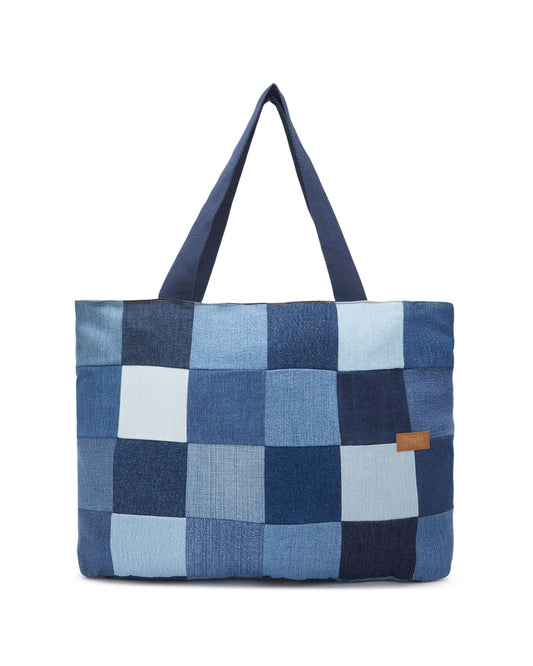
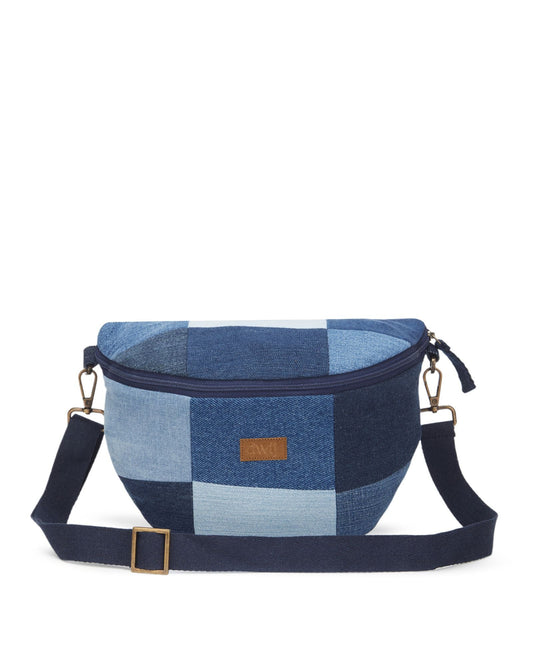
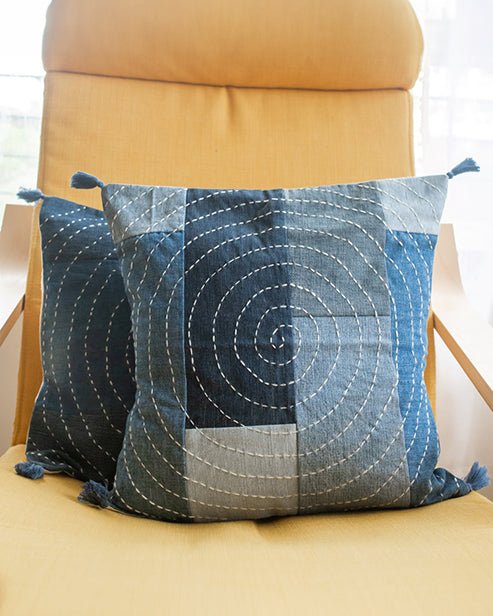
That is particularly visible in patchwork designs, where smaller pieces of denim are deliberately brought together.
The result is not a perfect reproduction.
It is a product shaped by the material that was available.
From Jeans to Something You Carry Every Day
At the beginning, it was a pair of jeans.
At the end, it might be a tote bag, backpack, sling bag, pouch or another everyday product.
The six steps look simple when written on a page:
Sourcing → Sorting → Washing → Cutting → Stitching → Ironing
But photographs reveal what those words cannot.
The piles of denim.
The variations in shade.
The hands sorting each piece.
The chalk marks before cutting.
The sewing machine.
The loose threads.
The final press.
The finished product.
That is why process photography matters.
It lets us see that an upcycled product isn't created by simply putting an old material into a new shape.
There is selection, preparation, design, skill and time between the two.
Why Dwij Documents the Process
Sustainability can sometimes become an abstract idea when all we see is the final product.
A photograph of a finished upcycled denim bag tells us what the product looks like.

A photograph of the denim being sorted tells us something else.
A photograph of the cutting table tells us something else again.
Together, the images show the transformation.
At Dwij, the process is part of the product story because the material's journey matters.
The objective is not simply to make something from waste.
It is to understand an existing material, use it thoughtfully, create something functional from it, and design the product with longevity in mind.
The journey from jeans to bags is therefore not just a manufacturing process.
It is the story of a material getting another chance.
FAQs About Turning Jeans Into Bags
1. How are old jeans turned into bags?
At Dwij, the documented six-step process is Sourcing, Sorting, Washing, Cutting, Stitching and Ironing. The denim is sourced, prepared and assessed before usable sections are cut according to the product design and stitched into a new product.
2. What are the six steps in Dwij's denim upcycling process?
The six steps are:
-
Sourcing
-
Sorting
-
Washing
-
Cutting
-
Stitching
-
Ironing
These stages take rescued denim from raw material to finished product.
3. Where does Dwij get the jeans used for its products?
Dwij works with post-consumer jeans as well as post-industrial denim and textile waste. Post-consumer denim can come through second-hand markets, collection channels and other sourcing routes.
4. Are old jeans washed before they are made into a Dwij bag?
Yes. Sourced denim is rigorously pre-washed through industrial washing processes handled by sourcing partners before the material enters the Dwij workshop.
5. How does Dwij decide which part of a pair of jeans to use?
The denim is assessed and sorted according to characteristics such as size, GSM, shade, condition and usability. Stronger or more suitable sections can be selected for different parts of a product, while smaller pieces can be considered for patchwork and other uses.
6. Does every upcycled denim bag look the same?
No. Variation in the original denim including shade, fading, texture and usable areas—can influence the finished product. This is one of the characteristics of working with rescued denim rather than uniform new fabric.
7. Is upcycling the same as recycling denim?
No. Upcycling generally keeps the existing material relatively intact and gives it a new use or function. Recycling can involve breaking textile material down into fibres or other raw materials.
Turning an existing pair of jeans into a bag is an example of upcycling.
8. What happens to denim scraps during upcycling?
Smaller pieces may be used for patchwork and other applications where their size makes them suitable. Dwij's process aims to work towards lower-waste practices and make useful use of available denim material wherever possible.
9. How long does it take to make an upcycled denim bag?
The time can vary depending on the product, its construction, the material available and the amount of handwork involved. Because Dwij products are tailor-made rather than mass manufactured, individual materials are handled and cut separately.
10. What can old jeans become besides a bag?
Depending on the condition and usable areas of the denim, it can potentially be transformed into different upcycled products, including bags, pouches, accessories and patchwork-based products.
From One Life to Another
A pair of jeans doesn't suddenly become a bag.
There is a journey in between.
Sourcing.
Sorting.
Washing.
Cutting.
Stitching.
Ironing.
Six documented steps.
And behind each one are decisions about material, design and craftsmanship.
So the next time you see an old pair of jeans, perhaps don't look only at what it has already been.
Look at what it could still become.
At Dwij, that's where the second life begins.