
Kutch's embroidery did not begin with the 2001 earthquake.
It had already been part of community life for generations.
Women from different communities in Kutch developed distinctive embroidery styles, passing stitches, motifs, colours, and techniques from one generation to the next. Today, Shrujan documents embroidery traditions across 12 communities, with more than 50 different styles represented among its craftswomen.
But on 26 January 2001, the landscape in which these traditions were practised changed dramatically.
The earthquake devastated homes, villages, livelihoods, workshops, and local infrastructure across Kutch.
What followed, however, was not simply a story of loss.
It became a story of rebuilding.
Craft organisations, community groups, designers, and artisans worked to restore livelihoods, document traditional knowledge, create new opportunities, and connect Kutch's handmade traditions with contemporary audiences.
The revival of Kutch embroidery after 2001 is therefore not a story about a craft that disappeared.
It is a story about a craft community that adapted, rebuilt, documented, and continued.
Kutch Had a Living Embroidery Culture Long Before 2001
To understand what happened after the earthquake, it helps to look further back.
Hand embroidery has been practised by women in Kutch for centuries as both personal expression and a marker of community identity.
And "Kutch embroidery" is not one single style.

Different communities have developed their own visual languages. Shrujan identifies 12 communities among the craftswomen it works with, including Ahir, Rabari, Meghwaad Gurjar, Mochi, Sodha, Jadeja, Jat, Mutva, and others. Each community has its own embroidery traditions, and some practise more than one style.
That diversity is important.
A colourful Rabari embroidery piece, a geometric Soof composition, and the work associated with other Kutchi communities may look very different, even though they all come from the same larger region.
The craft was never simply about decoration.
It carried identity.
The Revival Had Already Started Before the Earthquake
One of the most important parts of this story is often missed.
The organised revival of Kutch embroidery did not begin after 2001.
It began decades earlier.
In 1969, Chanda Shroff visited Dhaneti village during drought-relief work. She noticed the embroidery on the women's clothing and saw an opportunity to turn an existing skill into a source of dignified livelihood.
That led to the founding of Shrujan.
Rather than teaching women a completely new craft, the organisation built on knowledge that already existed within the communities. The women were already skilled embroiderers; the challenge was creating ways for that skill to generate sustainable income.
Over the following decades, Shrujan worked with craftswomen across Kutch, helping sustain embroidery while documenting its different styles and communities.
By the time the earthquake struck, therefore, there was already an established network supporting Kutch's embroidery traditions.
Then Came 26 January 2001
The earthquake of 26 January 2001 caused enormous destruction across Kutch.
Homes and infrastructure were damaged or destroyed. Craft livelihoods were affected alongside everything else.
But the earthquake did not erase the knowledge held by the artisans.
The skills were still there.
The stitches were still there.
The memories of motifs and patterns were still there.
And organisations already working in the region could respond from that foundation.
Contemporary accounts from the period describe Shrujan continuing to provide embroidery-related work and supplies to craftswomen living in temporary shelters after the earthquake, helping them maintain an income while rebuilding their lives.
That distinction matters.
The story wasn't simply "earthquake destroys craft."
It was:
"A disaster disrupted craft livelihoods, and existing craft networks became part of the recovery."
Craft Became Part of the Recovery
For many communities, rebuilding meant more than reconstructing physical homes.
It also meant rebuilding livelihoods.
Handcraft offered an important possibility because the skill already existed within the community.
Women could work from or near their villages, while organisations helped connect their work with markets, exhibitions, training, and new forms of product development.
A 2016 Indian Express profile of Kutch craftswomen, for example, documented how embroidery had become a source of income and greater independence for women working with Shrujan.
The value of the craft was therefore not only cultural.
It was economic.
It was social.
And for individual artisans, it could become deeply personal.
The Next Challenge: How Do You Keep a Tradition Alive?
Rebuilding a craft tradition is not simply about preserving old pieces.
A museum can preserve embroidered textiles.
But a living craft requires people who still know how to make it.
That means:
-
artisans need opportunities to practise;
-
younger generations need reasons to learn;
-
traditional designs need documentation;
-
communities need access to markets;
-
and consumers need to understand the difference between handmade craft and generic decoration.
This is where documentation became particularly important.
Shrujan undertook projects to research and record the embroidery heritage of Kutch, including forgotten designs, books, films, and oral histories.
The objective was not to freeze embroidery in time.
It was to help it remain alive.
From Memory to Archive
One of the most important developments in this journey was the creation of the Living and Learning Design Centre (LLDC).
The centre grew from the longer history of Shrujan's work with Kutch's craft communities and was inaugurated in 2016.
It was designed as more than a museum.
It functions as a crafts education and resource centre where craftspeople can meet, learn, document, and engage with their traditions.
The first museum exhibition, The Living Embroideries of Kutch, opened there in 2016.
That title says something important.
Living.
Not lost.
Not frozen.
Living.
The Design Centre on Wheels
One particularly interesting chapter in this story began even before the earthquake.
In the late 1990s, Shrujan developed the Design Centre on Wheels, a mobile museum that took embroidered panels and examples of Kutchi craft directly into villages.
Between 1997 and 2003, more than 1,000 embroidered panels and over 600 garments were created through the project, establishing a substantial visual archive of stitches, motifs, designs, and colour combinations. From 2003 to 2012, the mobile exhibition travelled through Kutch.
This meant that documentation did not simply happen by taking objects away from their communities.
The archive travelled back to the communities.
It became a way for artisans to see, compare, remember, and experiment.
Tradition Was Preserved by Allowing It to Evolve
This may be one of the most important lessons from Kutch.
Preserving a craft does not necessarily mean making every piece exactly as it was generations ago.
Traditions survive partly because makers find ways to use their knowledge in changing circumstances.
Shrujan's work has included helping craftswomen create new designs while maintaining traditional techniques and visual languages.
The result is a balance between continuity and change.
The stitch can remain.
The motif can remain.
The knowledge can remain.
But the product, colour combination, scale, or context can evolve.
That is not necessarily a loss of tradition.
Sometimes, it is how tradition survives.
Kutch Embroidery Became a Livelihood, Not Just a Heritage Object
The revival also changed the way people outside Kutch encountered the craft.
Embroidery moved beyond traditional clothing and household textiles into contemporary products.
Sarees, garments, accessories, bags, cushion covers, wall hangings, and other lifestyle products became ways for the skill to reach new audiences.
That transition created an important bridge.
The artisan did not have to abandon the traditional skill.
The consumer did not have to buy only a historically styled object.
Instead, the craft could enter contemporary life.
That is one reason craft revival can be more powerful than preservation alone.
Preservation protects memory.
Revival creates a future for it.
Kutch's Story Is Really About the Artisans
It can be tempting to tell the story through organisations.
Shrujan.
Khamir.
Kala Raksha.
LLDC.
These institutions matter.
But none of them are the craft.
The craft lives in the hands of people.
Kutch's embroidery traditions belong to communities whose knowledge has been passed down through generations. Shrujan's current network, for example, includes craftswomen from 12 different communities, each with distinctive traditions.
That is why the word artisan matters.
It isn't simply another word for worker.
An artisan carries technique, memory, judgement, and cultural knowledge.
When we buy a handcrafted object, we are not only buying the material.
We are buying time and skill.
What Kutch's Revival Can Teach Modern Design
The story of Kutch's embroidery revival has relevance beyond Gujarat.
It raises a larger question:
What happens when we stop treating craft as something belonging only to the past?
The answer can be surprisingly contemporary.
Craft can create livelihoods.
It can preserve cultural knowledge.
It can create new products.
It can support local economies.
It can give communities control over their own skills and stories.
And it can coexist with contemporary design.
This is particularly relevant to brands working with reclaimed materials.
Because sustainability isn't only about what a material is.
It is also about how it is made, who makes it, and how long its value can continue.
The Connection to dwij
At dwij, our work begins from a different material story, but there is a meaningful connection.
We work with post-consumer jeans and post-industrial denim and textile waste, transforming them into handcrafted products rather than treating the material as something with no further value. The brand's name, द्वि ज (dwij), means "twice born", a philosophy of giving materials a second life.

But material reuse is only one part of that philosophy.
We also believe in the value of human hands.
Our products are handcrafted rather than mass-produced, and we name and credit the people involved in making them.
That is why traditional Indian embroidery has a place within selected dwij hand-embroidered collections.
Our Kantha hand-embroidered collection and Kutch hand-embroidered collection bring traditional craft techniques and reclaimed denim together in contemporary products.
The intention isn't to claim that dwij is part of Kutch's historical revival.
It is simpler than that.
We share a belief that something does not lose its value simply because it comes from an earlier life.
A piece of denim can have another life.
A traditional stitch can have another context.
And an artisan's skill can remain relevant in contemporary products.
When Heritage Meets a Second Life
This is perhaps where Kutch's embroidery story becomes especially interesting for us.
Traditional craft often carries history through technique.

Upcycling carries history through material.
Put them together thoughtfully, and both histories can remain visible.
A piece of reclaimed denim can show its faded texture.
An embroidered motif can show the hand that created it.
The finished product does not need to erase either history.
At dwij, this combination of upcycled denim + handmade embroidery is one way we bring craft and circular design into the same object.
The result is not mass-produced uniformity.
It is something with variation.
Something with visible work.
Something that carries more than one story.
The Revival Is Still Happening
The word "revival" can make it sound as though there is a finish line.
There isn't one.
Craft traditions need continued practice.
They need markets that value handmade work.
They need younger makers.
They need documentation.
They need consumers who understand why a hand-embroidered piece takes time.
And they need space for artisans to evolve without losing ownership of their traditions.
Khamir, established in 2005 as a joint initiative of Kachchh Nav Nirman Abhiyan and the Nehru Foundation for Development, describes its work as strengthening and promoting Kachchh's artisanal traditions and creating a space where different stakeholders can collaborate. Today, Khamir works with artisans and artisan units across Kachchh.
The story therefore continues beyond the years immediately following 2001.
The earthquake was a major disruption.
The revival was a longer process.
And the craft itself continues to evolve.
What We Should Remember About Kutch Embroidery
The most useful way to remember this story is not:
"The earthquake almost destroyed Kutch embroidery."

That is too simple.
A better way to understand it is:
Kutch already had a deep, living embroidery culture. The 2001 earthquake severely disrupted lives and livelihoods, but it also became a catalyst for a renewed period of craft documentation, institutional support, livelihood rebuilding, and wider engagement with the region's traditions.
The stitches survived because people carried them.
The motifs survived because people remembered them.
The craft continued because artisans kept practising it.
And the revival worked because craft was treated not merely as an object to preserve, but as knowledge worth living from.
That may be the most important lesson.
A craft stays alive when the people who know it can continue to make it.
Frequently Asked Questions
What happened to Kutch embroidery after the 2001 earthquake?
The 2001 earthquake severely disrupted homes, livelihoods, infrastructure, and craft-related work across Kutch. However, the earthquake did not erase the region's embroidery traditions. Existing organisations and new craft initiatives became part of a longer process of rebuilding livelihoods, documenting traditions, supporting artisans, and connecting crafts with contemporary markets.
Did the 2001 earthquake destroy Kutch's embroidery tradition?
No. Kutch's embroidery traditions were deeply rooted in community life long before 2001. The earthquake caused severe disruption and loss, but the craft knowledge remained with artisan communities. The period that followed saw renewed efforts to support, document, teach, and develop the region's crafts.
Who helped revive Kutch's embroidery traditions?
Several organisations and individuals have contributed to craft revival in Kutch. Shrujan had already been working with craftswomen since 1969, while post-2001 initiatives included organisations such as Khamir and continued work through institutions including the Living and Learning Design Centre. Different organisations have focused on livelihoods, documentation, education, design development, and market access.
What is Shrujan's role in Kutch embroidery?
Shrujan was founded by Chanda Shroff in 1969 after she encountered the embroidery skills of women in Dhaneti during drought-relief work. It developed a model that connected existing craft skills with dignified livelihood opportunities and has continued to support, document, and promote Kutch's embroidery traditions.
What is the Living and Learning Design Centre?
The Living and Learning Design Centre (LLDC) is a crafts education, resource, and museum centre near Bhuj. It grew from the longer craft revival work associated with Shrujan and was inaugurated in 2016. Its work includes preserving and presenting Kutch's craft heritage while creating opportunities for craftspeople to learn and engage with their traditions.
How many embroidery traditions are there in Kutch?
There is no single fixed number that captures all of Kutch's embroidery diversity. Shrujan works with craftswomen from 12 communities and documents more than 50 embroidery styles among them. Different communities and subgroups have their own techniques, motifs, and visual languages.
Why is Kutch embroidery important?
Kutch embroidery is important because it carries community identity, cultural knowledge, artistic skill, and livelihood value. The traditions have been passed down across generations and continue to evolve through contemporary practice.
Does dwij use Kutch embroidery?
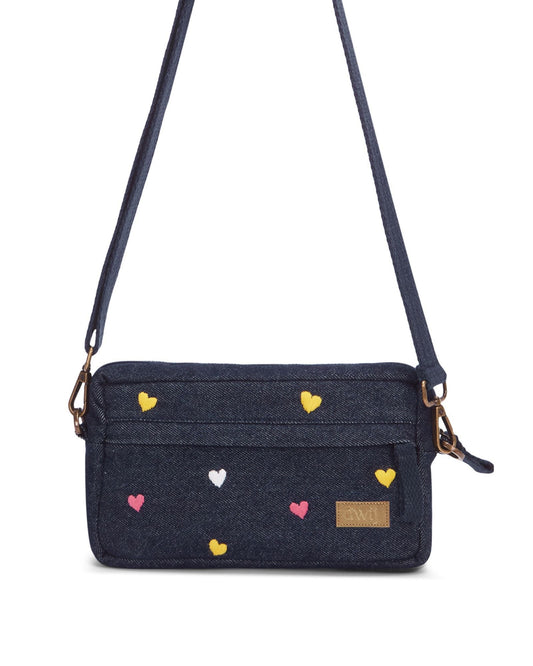
Yes. dwij has a Kutch hand-embroidered collection that brings Kutch-inspired hand embroidery together with reclaimed denim. The brand also has other hand-embroidered collections, including Kantha and heart embroidery.
How does dwij connect embroidery with upcycling?
dwij combines reclaimed denim with selected handmade embroidery techniques. The approach brings together two kinds of history: the previous life of the material and the cultural knowledge carried by the craft technique. This allows products to be contemporary while keeping visible elements of handcraft and material character.
What does dwij mean?
dwij (द्वि ज) means "twice born" in Sanskrit. It expresses the brand's philosophy of giving discarded materials another meaningful life through thoughtful design and craftsmanship.