
Sustainability is easy to talk about in theory. The harder question is: what does it look like when those ideas have to guide everyday decisions?
At dwij, founder Soumya Kalluri’s approach to sustainability comes from both engineering and live practice. In her TEDxJNTU Hyderabad talk, “Impact Living: Rethinking Consumption in Urban Life,” she explores how individuals can rethink consumption and make choices that create a meaningful impact. For dwij, these ideas do not stop at a stage or presentation, they influence how we source materials, design products, work with artisans, manage waste, and think about what happens to a product at the end of its life.
This is the story of how impact living moves from an idea into the daily practices behind an upcycled product.
What Does “Impact Living” Mean?
For us at dwij, impact living means looking beyond the immediate convenience of what we buy.
A product has an impact long before it reaches a customer. It involves:
-
What materials were used?
-
Where did those materials come from?
-
How much existing waste can be used instead of creating something new?
-
How was the product made?
-
How long will it remain useful?
-
What happens when it is no longer needed?
These questions are central to how we approach design.
Instead of seeing sustainability simply as a material choice, we look at the entire product lifecycle.
That thinking is closely connected to Soumya's engineering background and her experience with Life Cycle Assessment (LCA). At dwij, this has evolved into a practical philosophy: design with the entire life of a product in mind.
From TEDx Stage to the Dwij Workshop
Soumya’s Impact Living talk asks us to reconsider everyday consumption. At the dwij workshop, that idea becomes tangible.
A discarded pair of jeans isn't simply “waste.” We first ask what can be done with the material that already exists.
Our primary materials include:
-
Post-consumer jeans
-
Post-industrial denim waste
-
Recycled PET felt
-
Recovered denim scraps
These materials can have different shades, thicknesses, textures, seams, and previous uses. Instead of forcing every material into an identical production system, our design process responds to what is actually available.
That is where upcycling becomes a design challenge rather than just a production technique.
1. Material Honesty: Starting With What Already Exists
One of the most important principles behind our work is respecting the material.
Post-consumer denim already has a history. Natural fading, worn areas, pockets, seams and variations are evidence of that history.

We don't try to make every piece look identical.
In fact, we celebrate these differences.
At dwij, we do not use chemicals to create artificial washed effects. The naturally faded character of the denim becomes part of the final product.
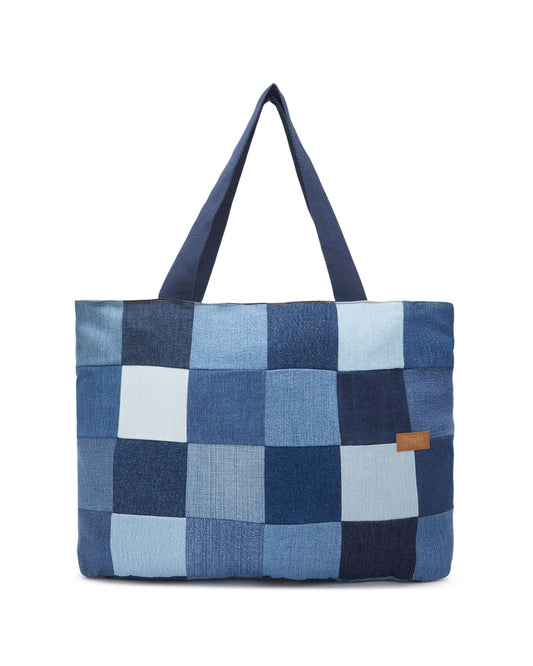
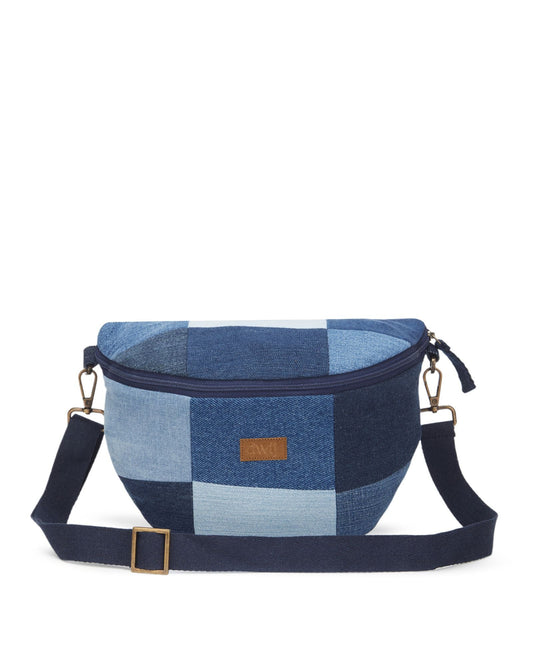
This approach can be seen across our denim tote bags, denim backpacks, laptop sleeves, sling bags, and other accessories.
The result is simple: the material tells us what it can become.
2. Circularity Starts Before the Product Is Designed
Circular design isn't only about recycling something after it becomes waste.
It begins much earlier with the design itself.
At dwij, our philosophy is based on design for disassembly. We consider what should happen to the different components of a product when it eventually reaches the end of its useful life.
That means thinking about:
-
Materials and their combinations
-
Stitching and construction
-
Components and hardware
-
Repairability
-
Future recycling or upcycling
Our aim is to avoid creating products that become difficult to separate simply because of the way they were manufactured.

This is one way Soumya's engineering perspective translates into everyday design decisions.
3. Low-Waste Design: Even Scraps Have Potential
Upcycling a pair of jeans doesn't mean every piece of fabric automatically becomes a large bag.
Some pieces are too small for major panels but that doesn't mean they have to become waste.
At dwij, we strive to follow a low-waste approach by using smaller denim scraps for patchwork and other applications wherever possible.

A tiny piece of denim can become part of:
-
Patchwork panels
-
Decorative details
This changes the question from:
“How much fabric do we need?”
to:
“How much of the material we already have can we meaningfully use?”
That shift is an important part of our circular design philosophy.
4. Craftsmanship Is Part of the Impact
Impact living isn't only about materials.
It is also about the people involved in making the product.
At dwij, we work with skilled artisans and incorporate handmade techniques into selected collections. Our products are handcrafted rather than mass-produced, allowing us to work thoughtfully with the character of each piece of denim.
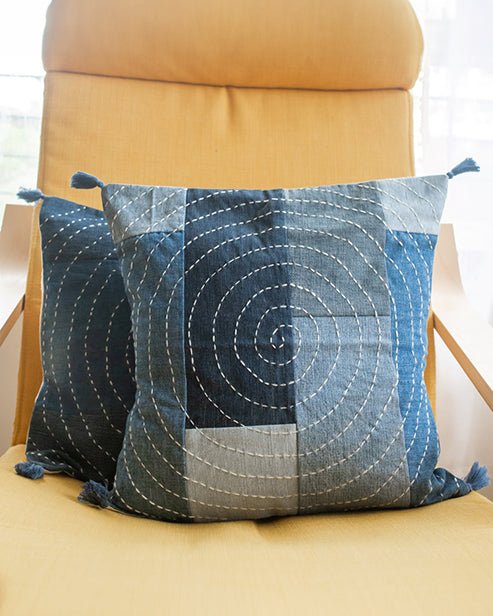
We also celebrate India's textile traditions through embroidery.

Our collections have included:
These techniques add more than decoration. They bring craftsmanship, cultural knowledge and human hands into products made from discarded materials.
The combination of upcycled denim + handmade embroidery allows an old material to become something contemporary without losing the value of traditional craft.
5. Choosing Better Components Matters Too
Circularity doesn't stop with the denim.
The smaller components used in a product also influence its durability and eventual end of life.

Depending on the product, dwij uses:
-
Premium-quality YKK Japanese zippers and sliders
-
Rust-free, non-corrosive white metal fittings
-
Recycled PET felt in selected designs
Durability is important because a product that lasts longer can remain useful for longer.
For us, sustainability isn't simply about creating something from waste. The finished product also needs to be functional enough to earn a place in someone's everyday life.
6. Designing for Use, Not Just for the Sustainability Story
A product can be made from rescued material and still fail if it isn't useful.
That is why functionality is central to our design process.
Our convertible tote bags, for example, are designed to adapt to different ways of carrying. Our laptop bags and laptop sleeves are created around everyday work and commuting needs. Our bottle holders, pouches, and smaller accessories are designed around simple, practical uses.

The objective is not to create a product that says “I am sustainable.”
It is to create a product that makes someone think:
“I want to use this every day.”
When a product becomes part of someone's routine, its useful life can extend far beyond the moment of purchase.
7. Impact Is Also About Buying Less, But Better
One of the ideas behind impact living is reconsidering consumption itself.
Sustainable consumption isn't necessarily about replacing everything you own with an “eco-friendly” alternative.

Sometimes, it means asking:
Do I need this?
And if the answer is yes:
Can I choose something durable, useful and thoughtfully made?
A versatile product that serves multiple purposes can help reduce the need for several single-purpose products.
This is why we focus on functionality, longevity and timeless design rather than chasing every short-lived trend.
For us, buying better also means using what you buy for longer.
What Happens to the Waste Created During Production?
A low-waste philosophy requires attention beyond the main fabric panels.
When working with denim, there will inevitably be smaller pieces that cannot be incorporated into a particular design.

Our approach is to look for ways to use these scraps wherever possible, including patchwork and smaller products.
This is not about claiming that every piece of denim can be used indefinitely.
It is about continuously asking:
Can this material have another useful purpose before it becomes waste?
That mindset is at the heart of our circular approach.
Impact Living Is a System, Not a Single Product
A denim tote bag by itself cannot solve textile waste.
Neither can an individual purchase.

The bigger impact comes from connecting multiple decisions:
Source existing waste → design thoughtfully → use materials efficiently → support craftsmanship → create durable products → design for disassembly → keep materials in circulation.
That is the ecosystem we are trying to build at dwij.
Our philosophy is rooted in the belief that discarded materials can become valuable again when we approach them with intention.
From Engineering to Everyday Circularity
Soumya's journey from engineering and Life Cycle Assessment to building dwij has shaped how we think about sustainability.
Engineering asks us to understand systems.

Craft asks us to pay attention to materials and hands.
Circular design asks us to think about what happens next.
At dwij, these ideas come together in something very tangible: a piece of discarded denim being transformed into a product designed for everyday use.
That could be a denim backpack, a convertible tote, a laptop sleeve, a denim home accessory, or a hand-embroidered piece.
The product is only one part of the story.
The bigger story is what happens to the material before and after it becomes that product.
Why Impact Living Matters at Dwij
For us, impact living isn't about perfection.
It is about making more conscious decisions at every stage.

It means questioning unnecessary consumption.
It means seeing waste as a resource.
It means designing products with their future in mind.
It means valuing the people and skills behind handmade work.
And it means creating products that are useful enough to be used, loved and carried for years.
That is how an idea from a TEDx stage can show up on a workshop floor not as a slogan, but as a series of everyday choices.
At dwij, “second life” is not just what happens to a pair of jeans. It is the way we choose to design, make and consume.
Frequently Asked Questions
What is Soumya Kalluri's TEDx talk about?
Soumya Kalluri's TEDxJNTU Hyderabad talk, “Impact Living: Rethinking Consumption in Urban Life,” explores how people can rethink everyday consumption and make choices that create more meaningful environmental and social impact.
How does Soumya's engineering background influence dwij?
Soumya's engineering background and experience with Life Cycle Assessment (LCA) influenced dwij's focus on systems thinking, material use, product longevity and design for disassembly. These principles help translate sustainability from an idea into practical product-design decisions.
What does “impact living” mean at dwij?
At dwij, impact living means considering the complete lifecycle of a product from sourcing existing materials and minimising production waste to creating durable products and thinking about what happens to them at the end of their useful life.
How does dwij reduce textile waste?
dwij uses post-consumer jeans and post-industrial denim waste as key raw materials. The brand also strives for a low-waste production approach by using smaller denim scraps for patchwork, accessories and other applications wherever possible.
Does dwij use handmade embroidery?
Yes. dwij has created collections featuring Kantha hand embroidery, Kutch hand embroidery and Heart hand embroidery. These techniques combine upcycled denim with Indian craftsmanship and help support skilled artisan work.
What is the design for disassembly?
Design for disassembly means designing products so their different materials and components can be separated more easily at the end of their useful life. At dwij, this philosophy helps us consider future recycling or upcycling while designing products today.
Why does dwij use naturally faded denim?
We preserve the authentic character of denim created through previous wear and use. We do not use chemicals to artificially create washed effects. Natural fading, textures and marks become part of each product's individual character.
Is impact living about buying more sustainable products?
Not necessarily. At dwij, we believe conscious consumption also means questioning whether you need something, choosing products for their usefulness and durability when you do, and using them for as long as possible. Sustainability is about how we consume, not simply what label a product carries.